Category

News

The Lasting Influence of War and Peace

By | News

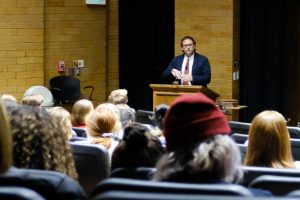
Mark Purves lecturing on War and Peace at International Cinema 27 Jan 2020

“No work of art has informed my worldview like Tolstoy’s War & Peace,” said Dr. Mark Purves, professor of Russian literature. Purves focused his lecture on the history and importance of Tolstoy’s novel, which was adapted in 1966 by Sergey Bondarchuk into a massive seven-hour film. The International Cinema will be screen each of War & Peace’s four chapters separately with one showing each week. This week War & Peace: Andrei Bolkonsky begins the epic journey. 

Tolstoy, Purves observed, was already popular before the serial release of War & Peace in 1865. In this work, he initially set out to write a history of Peter the Great, but he became so enamored with the rise and attack of Napoleon he scrapped the first half of the project. Even after having written for over a year (remember he was publishing serially), Tolstoy dropped the intended protagonist. The project evolved as he continued to write and it eventually covered fifteen years of Russian history. To do so, Tolstoy used his fame to gain access to archives where he unearthed much of the forgotten history of the period. 

Initially, his novel was not well received in the West as it did not fit neatly into any existing genre. In Russian literary circles, however, it was immediately heralded as a classic for precisely the same reason. Purves suggested that Tolstoy’s genius was in his focused descriptions of seemingly small, personal moments. “For Tolstoy,” Purves said, “humanity doesn’t exist. There are only millions of [individual] human beings possessed of desires and illusions which are at war with each other and within themselves.” Rather than focusing on the tsar’s presence at a ball, for instance, the novel and film follow a young teenager, Natasha Rostova, as she first experiences the feelings of love. Natasha has little to do with Russia’s fight against the invading French dictator, but Tolstoy is more interested in the personal than the great movements of history.

This emphasis in the immediate rather than the grand leads to a sense of importance in the here-and-now over and against what Tolstoy called “The tyranny of elsewhere.” In cinematic terms, Tolstoy wants his readers to rack their temporal and chronological focus to the here and now. “God must love the little moments,” one critic wrote, “because he created so many of them.”

It is clear from the film adaptation’s runtime alone that it adheres quite closely to Tolstoy’s novel. There are several different adaptations, but Sergey Bondarchuk’s version is not only the most complete but by far the most epic in scale. The representation of Napoleon’s invasion in the film is bound to amaze any film viewer, but what is far more impressive is Bondarchuk’s further emphasis of Tolstoy’s interest in the personal. Bondarchuk, of course, emphasizes certain aspects of the novel in response to his own interests and political climate. This is particularly apparent in the film’s emphatic condemnation of hero worship, but Purves ended by saying that Bondarchuk’s interpretation, “is as relevant to contemporary audiences as it was to those watching its premiere in 1966.”
Jennifer Fay and Imaging Deep Time in the Present

By | News

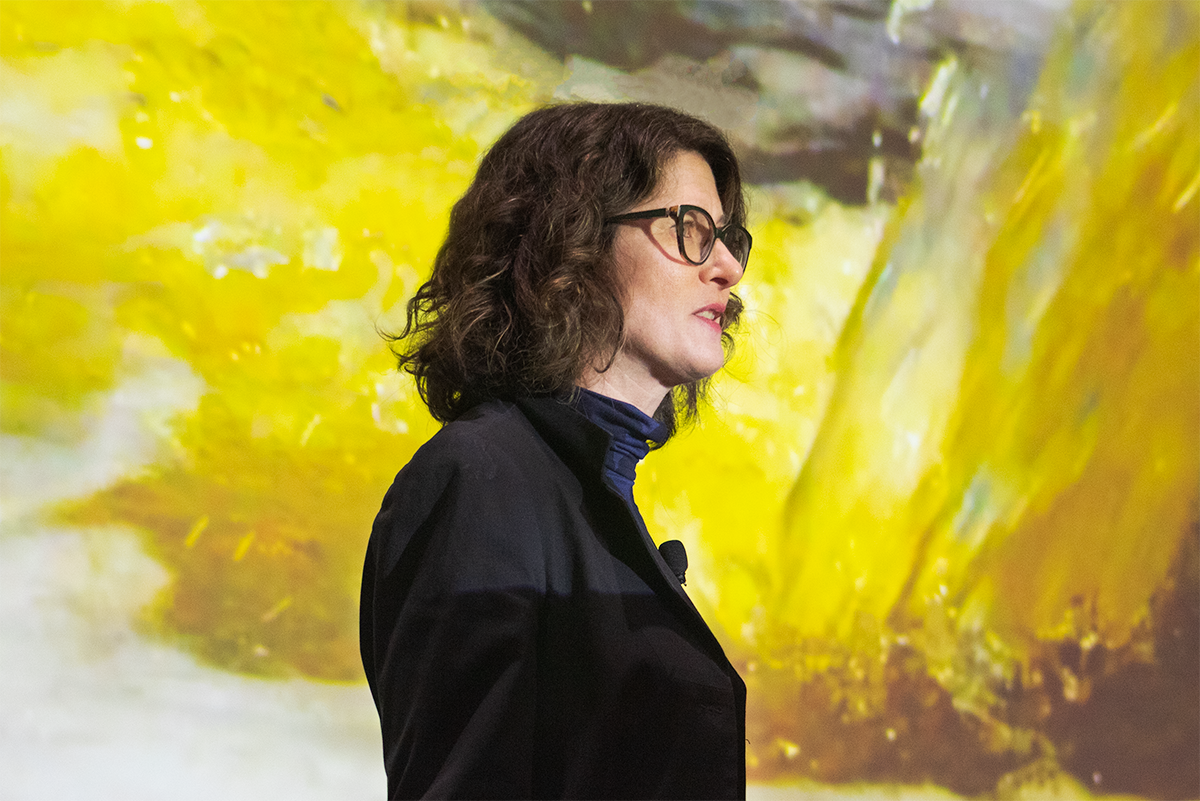
“How do we live in the present with the sense of being geological subjects?” asked Dr. Jennifer Fay, director of Cinema and Media Studies at Vanderbilt University. Anthropocene: The Human Epoch (2018) attempts to help us imagine the deep time of both the future and the past and consider the relative scale of human action. The Anthropocene is a designation that has been proposed to label our current geological epoch. It is defined by the evidence of human life that has been left in the layers of the earth’s crust. The Anthropocene, according to some, is most clearly marked by traces of radioactive particles from nuclear testing and bombing. When future geologists return to the rock layers that categorize the planet’s geological history, billions of years in the making, they will be able to precisely locate when humans left their mark, a time when humanity was at both its most inhumane and unnatural. 

Fay questioned how we can make the overwhelming scale of our geological pressure on the planet interesting and understandable to movie audiences. We do not live our daily lives on the scale of climatary or planetary cycles, so how can we wrap our minds around the massive space and time considered in these geological definitions. Some films present natural disasters, didactic messages, evil villains, or political strikes, all of which reduce the size of climate change to specific areas or people. 

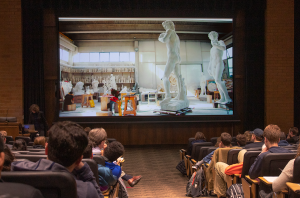
But Anthropocene takes a slightly different approach focusing on particular examples that are presented in such a way so as to allow the audience to draw their own conclusions. For example, the Carrara Quarry in Italy where the marble for Michelangelo’s David was sourced is still active today, but now with fossil fueled machinery they can extract in a matter of days what used to take months with man power. The use of fossil fuels has led to an acceleration in human capacity to destroy. Only a few days were needed to remove what took millions of years to form. Fay argued that this quarry is a prime example of how Anthropocene: The Human Epoch attempts to relate the scale of geological time to the human scale. 

What about space? How do we imagine the massive amount of land that has changed because of humans. Fay pointed to another example in the film, that of a brown coal mine in Germany. This brown coal will be used to fuel other industries, perhaps like that of the Carrara Quarry, and will release more carbon into the atmosphere. In order to dig up this coal, this mine makes use of the largest terrestrial machine ever. By showing human figures dwarfed by this massive machine and then cutting to an even longer shot of the machine dwarfed by the larger landscape around it, the film relays how rapidly we extract what took millions of years to form. We could not undo in a life-time what our machines do in days. 

The film, according to Fay, also asks if we know what destruction looks like? The mines and the quarry are clear examples of human disruption and the Pacific Northwest is often the poster child for nature, but what about biomes like deserts? If there is no green, can we differentiate a natural image from one shaped by human activity? For example, lithium pools, created in the process of lithium extraction, are clearly catastrophes, but these are the byproduct of the lithium batteries needed in electric cars. We recognize some images of unnatural, like the lithium pools, but we celebrate rows of alfalfa for being natural when those massive, industrial farms are also catastrophic for the environment. According to Fay, “We don’t know what it is we have lost… We are the first humans to experience a geological epoch change.” Humanity does not recall what the world looked like before the groundwork of the Anthropocene was laid. Does such a thing as a “natural image” even exist? How can we learn to live with ourselves recognizing that collectively we have become nothing short of a planetary force?

How The Godfather Saved/Changed Hollywood

By | News


The Godfather ushered in a new era,” claimed Dr. Darl Larsen, professor of Theater and Media Arts. Hollywood film studios changed their structure because of the success of Fancis Ford Coppola’s blockbuster hit, The Godfather (1972). Throughout the 40s and 50s, Hollywood studios experienced significant strength and stability, but new media such as television began to threaten their dominance as well as the more experimental and thematically frank foreign films that made their way to American theaters throughout the 50s and 60s, American audiences wanted to see things that were more complex. Foreign films were not under any obligation to self-censor sex and violence, so they were marketed towards Americans as being more titillating, although whether the content was actually more explicit is up for debate according to Larsen. American audiences were drawn to these more challenging, foreign films because of the more extreme cultural circumstances of the 60s, including race riots, the war in Vietnam, and a myriad of political assassinations around the world. Movies, they thought, should reflect the darkness of real life and the news.

Hollywood was slow on the uptake. Westerns had more or less wandered into the setting sun and musicals were soon to follow. After the success of The Sound of Music in 1965, the studios thought that they could pour money into big musicals again, but after three massive flops including Doctor Dolittle (1967), Star! (1968), and Hello, Dolly! (1969) the days of the Hollywood musical came to a close as did the doors of MGM Studios. Hollywood needed to fundamentally change in order to survive. “The Godfather was directed by nobody,” Larsen joked, “That’s not true. It was directed by a nobody.” Francis Ford Coppola, as opposed to the Hollywood directors who preceded him, went to film school as opposed to having worked his way slowly up the ladder after working every job on the lot. 

In film school, which was relatively new, Coppola studied film both practically and critically. He watched all the great American and foreign films from the festivals and learned how different lenses, angles, sounds, etc. affect audiences. Despite rather disliking the novel, Coppola was sought after to direct The Godfather in part because he himself was Italian-American and because the studio knew they needed some fresh new vision. The Godfather became the first Hollywood blockbuster. It was a book. It was a movie. It was a soundtrack. All of these elements were mass marketed to push each other for greater sales and the film opened not in hundreds but in thousands of theaters to massive critical and audience acclaim. 
Because of The Godfather’s success, the studios shifted to center more around these blockbusters or “event films.” Studios also started looking for their next directors in recent film school alumni. There would be no Jaws (1975), no Star Wars (1977), no Taxi Driver (1976) were it not for Coppola and The Godfather.

International Cinema Class: ICS 290R

By | News

Did you know that you can get credit for going to International Cinema? Add ICS 290R to your schedule and you will get credit for going to IC’s great films and lectures. Meets every Wednesday at 4pm in 250 KMBL. For questions, contact Prof. Chip Oscarson (oscarson@byu.edu).

Bruce Lee’s Ligaments, Life, and Legacy

By | News

“Here are my Jeet Kune Do gloves and my nunchucks.” Dr. Matt Ancell began his lecture on Bruce Lee’s legacy and Enter the Dragon (1973) by pulling out evidence of Lee’s influence on him as a young boy. Ancell gave a brief outline of Lee’s life and works leading up to Enter the Dragon, then offered an explanation as to why this film might be screened at the International Cinema.

Bruce Lee was of European and Chinese descent but was born in America. His family returned to Hong Kong when he was still young, and he worked as a child actor while being raised by his father, a famous Opera singer. He never garnered much attention as a child actor, but nor did he ever lose the desire to make films. Because Lee got into many fights in Hong Kong, his parents eventually moved him back to America to continue his education. Lee stopped working in film for a time as he trained in Wing Chun style martial arts and studied philosophy and drama at the University of Washington.

Lee was found to be training non-Chinese people in Chinese martial arts, an affront to the Chinese community and was challenged to a duel. Because he had only studied the Wing Chun style, a very sedentary, immobile tradition, he was quickly worn out by his opponent’s fleeting movements. This fight was the impetus for Lee’s new philosophically based style: Jeet Kune Do (the way of the intercepting fist). Jeet Kune Do is characterized as a style without a style. Lee described it in an interview as, “Be[ing] formless, like water.” In Jeet Kune Do, one choses to utilize whatever would work best for an actual fight rather than sticking exclusively to one style. You can use the arm movements from Wing Chun or boxing, the leg movements from Judo or Karate, and any brawler techniques (such as when Lee rips off Chuck Norris’s chest hair in The Way of the Dragon [1972]).

Lee eventually began working in Hollywood playing almost exclusively stereotypical and subservient characters, much to his dissatisfaction. After butting heads with a number of studios and having his ideas rejected or stolen, Lee decided to return to Hong Kong, where unbeknownst to him, he was already a huge star. The TV series, The Green Hornet (1966), in which Lee played Kato the martial artist/chauffeur/sidekick, was being shown in Hong Kong under the title The Kato Show.

While Lee had been in America, the types of films made in Hong Kong had radically changed. Due to the increased violence of the 1960s riots, the Hong Kong film industry had become more realistic in its depictions of violence. No longer were the martial artists using such fancy tricks with the camera helping to avoid their failures. These new films that appeared immediately before Lee returned, featured more authentic fights that mirrored the types of violence the protesters faced under the British police force.

Lee was perfectly suited to this type of filmmaking because he truly was a phenomenally powerful martial artist. According to Ancell, Lee was just an okay actor, but he had an “incredible screen presence.” After two back-to-back record-breaking hits with Golden Harvest (a production company), Lee wrote, directed, and starred in The Way of the Dragon. Hollywood then took note of how marketable Lee was and struck a deal for a co-production between Golden Harvest and Warner Bros. for a new film called Enter the Dragon.

Enter the Dragon was originally billed as something of a James Bond film, where the British star, John Saxon, was to lead a team of three and infiltrate the antagonist’s island base. Of course, Hong Kong did not like seeing the British take all the credit, nor did Bruce Lee, so Lee strong-armed the production into letting him direct the opening scenes of the film which set his character as the central protagonist. What the film became is something of a genre-blending picture. Lee introduces elements of the martial arts genre, Saxon the spy genre, and Jim Kelley the blaxploitation genre. We are left with three characters working together but who approach the narrative almost as if they each carry their respective genres with them. Enter the Dragon, then presents viewers with a fascinating example of how international financing, the star system, and film genres all push and pull when making popular movies.

Just one month before the release of Enter the Dragon, Lee died. The film went on to be a huge success world-wide. Because of his unparalleled skill and charisma, Lee’s image continued in the popular imagination. Dozens of imitators immediately sprang up, leading to what have been coined as “Brucesploitation” films. His masculinized and sexualized, Asian, male body also led to a change in desired American, male bodies in film, and he is popularly known as “the grandfather of MMA” for his Jeet Kune Do style.

The Bridge, an Autopsy

By | News, Uncategorized

“When I say that word ‘bridge,’ what do you think of? I would bet you think of connection.” Dr. Nate Kramer of the Department of Comparative Arts and Letters, a specialist in Scandinavian culture, spoke about the Danish-Swedish co-produced TV series The Bridge (2011) at the regular International Cinema Wednesday lecture 20 November. The premise of this hit TV show is that a corpse is found on the bridge exactly between Denmark and Sweden. Because the body is placed right on the border and because it turns out to be two bodies—one half a Dane, one half a Swede—detectives from both have to work together to solve the case. 

Prof. Kramer talked about how The Bridge draws upon various television genres. First off, it is like a police procedural. Shows like CSI (2000), Bones (2005), and Hawaii Five-O (1968) are all American examples, but most countries also have their own police procedurals. These shows, as Prof. Kramer emphasized, are not necessarily whodunnits, rather they examine the processes. They show the autopsies, evidence collections, warrants, and legal proceedings more than the actual chase of criminals. 

Equally important in terms of the episodes’ runtime as well as audience interest is the relationship between the detectives. This is particularly true in The Bridge in which the interaction between the two lead detectives becomes a primary focus of the plot, almost more so than the investigation itself. The show draws on popular inter-Scandinavian stereotypes as Saga, the Swede, is incredibly organized, uptight, but lacking empathy, while Martin, the Dane, is relaxed, friendly, but with a messy personal life. 

The Bridge is also a good example of “Nordic Noir.” “You can think about [Nordic Noir] like the Scandinavian version of a police procedural,” but Kramer wants IC viewers to understand that there is more to Nordic Noir than that. This is also a literary genre, which has now made its way into TV and film, usually about a crime using prose that is rather plain and direct and avoiding metaphors. but, crucially, the narratives are very specifically located. Many are critiques of the Scandinavian welfare state, so their geographical specificity is key. The titular bridge in The Bridge is not just any bridge, but the very recognizable Øresund bridge. So, viewers need to understand that this bridge is not a stand-in for all bridges, nor are the relations between Sweden and Denmark emblematic of all bordering nations. 

That being said, and here Prof. Kramer asked us to forgive the seemingly contradictory statements, that “this TV show leverages the symbolic power of bridges.” While a bridge is something that normally connects, as does the Øresund Bridge, they can also serve to bisect. Bridges are places where flows can be halted, where cultures can be separated, and people searched. Tapping into this idea of connection and bisection is, Prof. Kramer claims, why this TV show has been so popular as to have four different remakes around the world: England and France, USA and Mexico, Germany and Austria, and Malaysia and Singapore. All over the world, there are unique areas that embody the same symbolic power of the bridge to illustrate the contradiction of international connections.

Representing Blackness in American Cinema

By | News

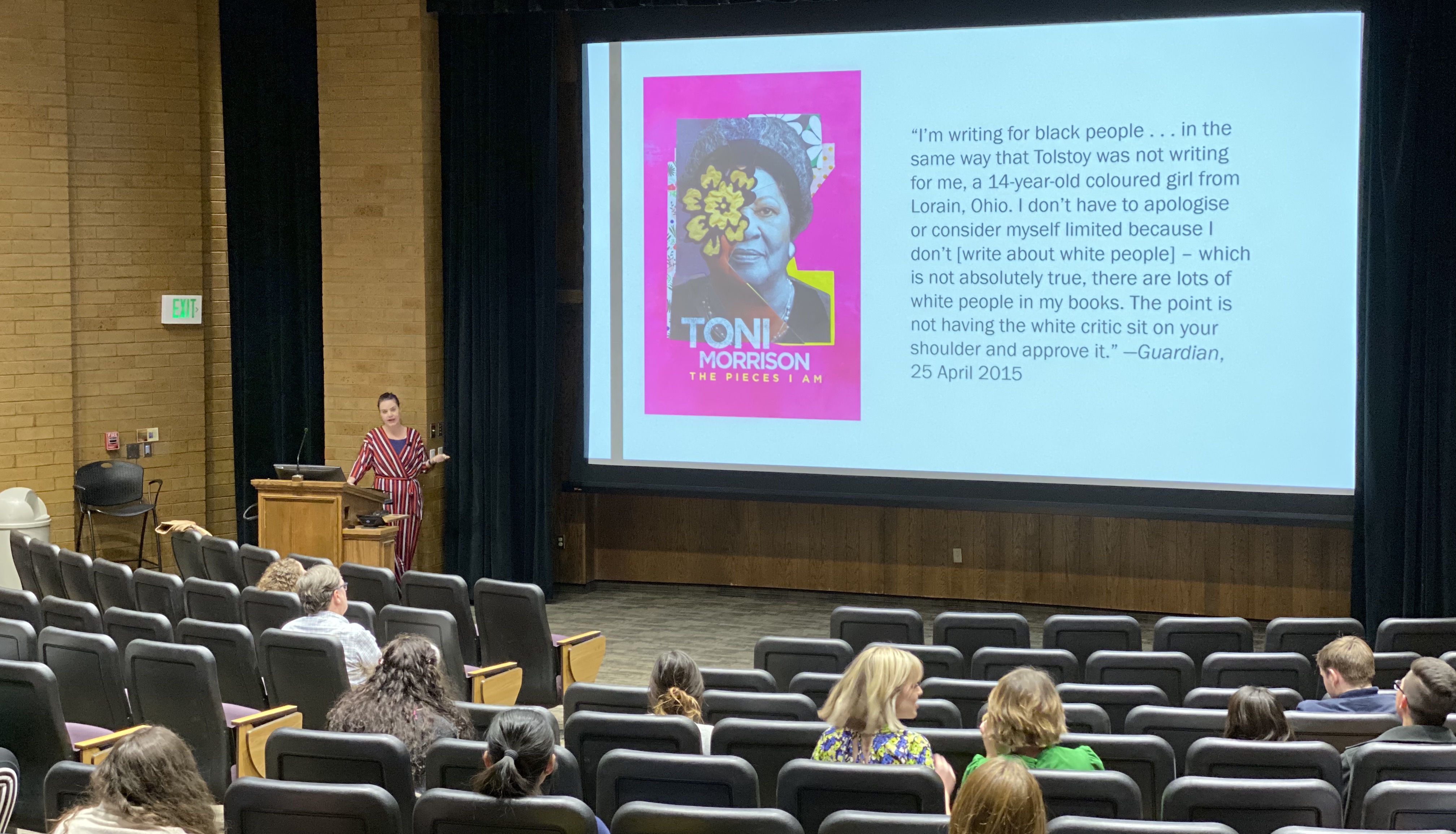
“Racism is racial prejudice plus power,” said Dr. Kristin Matthews of the Department of English. Matthews gave a lecture before a screening of Toni Morrison: The Pieces I Am (2019) and touched on two other films in our Representing Race series: Green Book (2018) and If Beale Street Could Talk (2018).

She began with a short overview of some of the ways people of color have been represented and marginalized in American film history. Early American cinema showed blackness in a very limited way, usually through caricatures. Classic films like Birth of a Nation (1915) showed people of color as being criminalistic, savage, and violent. They were presented as threats to society, the nation, and white women specifically. A typical stereotype was the “bumbling, ignorant negro” who is used as comic relief in movies such as Sullivan’s Travels (1941) and Judge Priest (1934) or for black women, characters like Mammy (Hattie McDaniel) in Gone With the Wind (1939), a house slave to a wealthy white family to whom she shows great affection. “The Wise Negro” is yet another stereotype of black people in American film in which an older, black person gives sage advice to the struggling white protagonist without any desires for themselves. Films like Driving Miss Daisy (1989) and The Legend of Bagger Vance (2000) employ this trope to paint black people as a tool or mechanism rather than as fully realized human characters. These and other stock characters were continually used to subjugate people of color and to reinforce race relations in terms of white supremacy: an instance of racial prejudice being elevated with power.

Another common and persistent representation of blackness in film was through blackface. Blackface is when a non-black person paints their skin to mimic a grotesque caricature of a person of color. We see this in such famous films as Othello (1965) and The Jazz Singer (1927). Blackface is used as a sort of power fantasy by non-blacks to reinforce harmful stereotypes. 

People of color have also been mistreated by the American film industry through the “White Saviour” narrative. This is when a white character saves the black characters or helps them to understand what it is to be black, thus giving power again to white people and subjugating black individualism and power. Some examples of “White Saviour” films include The Help (2011) and Green Book (2018). Contrary to reality, racism in these films is presented as a personal problem. A few bad apples of extreme racism in these films make white viewers (who may not understand how their privilege has benefitted them) feel safe, secure, and certainly not racist themselves. These stereotypes also double down on white supremacist notions of power consolidation under whiteness as ultimately beneficial for people of color. 

The author Toni Morrison wrote in this world of stereotypes which were—and are—prevalent in both film and literature. She challenged these notions of blackness as lesser-than in her own writing and in her work as an editor. “She published books that were deliberately black,” according to Matthews, and her work “corrects false stories and offers a range of black individuals” as opposed to the white imagination of blackness and black people as monolithic. 

Matthews left the audience with a number of questions to ask oneself when watching a film that may help to recognize the degree to which blackness is being fairly represented. Who benefits from the film? Who makes money off of this production? Does it maintain the status quo or challenge systemic institutional oppression? Who is empowered? Are the people of color characters or caricatures? And, does the film work to make white audiences comfortable?

Q&A with Filmmaker Emelie Mahdavian

By | News

Emelie Mahdavian is the producer, editor, and screenwriter for Midnight Traveler (2019), an award winning documentary directed by Hassan Fazili about his family’s escape from Afghanistan and the Taliban and their arduous (and circuitous) journey to Europe. The Fazilis’ experience as refugees was shot completely on the family’s smartphones and then put together by Mahdavian and a team of filmmakers. Mahdavian held a discussion after a screening of the film at the IC. 

Mahdavian was already part of the project while the family was traveling. She understood what Western audiences would expect from a documentary in terms of structure, and so it was her task to provide that for the film. It was much less collaborative than most projects because the director was on the other side of the planet and in the middle of dangerous situations. Mahdavian decided to end the film after the family’s arrival in Hungary as it shows how their lives are not settled just because they’ve arrived in the EU. This was just the beginning of another long process.

The goal for the film, said Mahdavian, was to make it feel as if you are traveling with the family, but the film also needed a narrative arc. These two things, she said, do not always line up nicely. So there are certain images that while powerful, were cut out because they weren’t primarily about the family and their journey. This was also one of the reasons Mahdavian chose to retain as much of the shaky, handheld, low-budget effects of the phone camera–complete with autofocus issues, shakes, overexposures, etc.–so as to make it feel more familiar and immediate to the viewers.

With over three hundred hours of footage to work with, Mahdavian had to decide what story to tell. She was most interested in showing the family as individuals so she included only those things pertinent to their case and had to limit the material about others they met along the way. She did not want the family to be faceless husks standing in as representatives of every refugee in the world. This is why the film focuses on the quiet, personal moments that are unique to them and tries to avoid generalizations. This also helps to sidestep the problem of other refugee films that, according to Mahdavian, fetishize the refugee. She said, “This is a family’s story. Not a story of all refugees.” Showing them as humans who are not accustomed to this type of suffering helps keep audiences from thinking of refugees as deserving or comfortable with their travels.

Friends and colleagues along the way met the Fazilis to back up the footage on hard drives and send it to Mahdavian in the United States. The family filmed on personal smartphones–some of which had to be replaced–and did not have a way to back up the footage themselves. Consequently, some of the voiceovers were recorded by Mahdavian when she met them in Serbia. Others were re-recorded later when the family arrived in Germany to match images and for better quality. Some events, however, were too raw to re-record, for example the father’s dream when they search for their missing daughter. The sound from these sequences had to be kept as any attempt to recreate the emotions in Fazili’s voice would fall short. 

When asked if there were any clips she wished she had when editing together the film, Mahdavian replied, “Every editor on any project feels this!” She continued saying that in the editing process there is also a dream of moving the camera for a better shot but it’s just not possible, especially in this case. The voiceover in the film helps to fill in gaps, such as in the scene when the family is attacked by fascists. You don’t actually see the attack just the aftermath, so the voiceover is needed to give the scene context.

The sound design, said Mahdavian, “is actually my favorite part of the movie!” She and her team tried to use as much original sound as possible, but smartphones aren’t ideal for sound recording. Subtitles can help when the quality makes it difficult to hear, but the sound designers had to fill in the soundscape and did so with a mixture of organic and electronic sounds. They had to create a feeling of the space because they rarely had much ambient sound to work with. The soundtrack and sound design at times become indistinguishable on purpose. For example, one of the themes in the music is a chord done with voices that is based on the sounds of the car engine’s rumbling from the raw footage. 

When asked about her favorite scene, Mahdavian exclaim, “When they fight! That is also [the mother’s] favorite scene!” Mahdavian also explained that the family is now living in Germany but have not yet been accepted for full residency. When asked if the father was still filming, Mahdavian responded with a smile, “I don’t ask.”

Celebrating the Day of the Dead through Mexican Film

By | News

Macario (1960) was made at the end of the Golden Age of Mexican Cinema. It’s a simple story of a man who wishes that more than anything he could eat an entire turkey himself without needing to share with his perpetually hungry family. Like other films from the Golden Age, it is interested in what are perceived to be uniquely Mexican themes like rural Mexican life, poverty, and the inquisition. Macario, the titular character is also coded as being of indigenous descent. Beyond the story, however, the cinematography, according to Dr. Doug Weatherford (Spanish and Portuguese), is the cinematography, is what sets this film apart.

The director of photography (cinematographer) for Macario was Gabriel Figueroa — “The Father of Mexican Cinematography.” His career spanned five decades and he made films with some of the biggest directors ever including John Huston, Don Siegel, John Ford, and even Luis Buñuel. He offered what he and others considered to be a visual style that was solely Mexican achieved through varied and interesting angles, a closed (aesthetic) style, oblique perspectives (where objects are seen from corners so they have two vanishing points), dialectical elements with high contrast, and low horizon lines that highlighted the endless Mexican sky.

Macario features many of these elements but not all. Other films shot by Figueroa may be better but few deal with such an important holiday. Día de los Muertos serves as a background for the film’s narrative, and as Macario dreams about his turkey, the town is filled with sugar skulls, skeletons and offerings for families’ ancestors. When Macario enters Death’s cave, the candles representing human lives are all real and posed a tremendously difficult situation in which Figueroa had to film. Figueroa’s influence is still felt today including in Hollywood with significant awards in recent year going to Mexican filmmakers who owe much in their style to the work of pioneers like Figueroa.