Category

News

Russia and the Unnaturalness of Democracy

By | News

“How many of you were alive during the ‘80s?” asked UVU President Dr. Astrid Tuminez during her post-screening discussion of Meeting Gorbachev (2018) on Wednesday, Oct 30th. “Oh good!” she exclaimed after almost half of the audience raised their hands. Tuminez graduated from BYU and continued her studies in International Relations and the history of Russia at Harvard. While at Harvard, she participated in a group interested in strengthening democratic institutions around the world, and for a time she was stationed in Moscow. Over the years, Tuminez interviewed Mikhail Gorbachev four times, even more than Werner Herzog, the director of the film. 

In the late ‘80s and early 90s, there was an intense sense in the Soviet Union that the country and nation were falling apart, according to Tuminez. The documentary engages the big history, but focuses on the portrait of a single leader. Gorbachev is, of course, recognized as one of the pivotal leaders who put an end to the Cold War, but the film goes beyond the facts by humanizing him, particularly with a touching section about Gorbachev’s relationship with his wife, a partnership that was amazingly close and loving. The film paints Gorbachev as a person who was genuinely interested in helping people through the benefits of both democracy and socialism. 

Tuminez was there during the attempted military coup in Moscow when Gorbachev was vacationing in Crimea and military leaders along with hardliners came to take the city. Their attempt was unsuccessful as the people rose up to stop the troops. Boris Yeltsin, the man who displaced Gorbachev and became the new leader of Russia, used the opportunity to climb on one of the abandoned tanks and paint himself as a man of the people. Not long after, Yeltsin and others held a secret meeting to disband the USSR in a clear grab for power. Gorbachev still regrets the end of the USSR to this day. He says in the film that it was too quick and was driven by people who were too hasty. 

Tuminez researches the history of the dissolution of the Soviet Union and its aftermath. When state-owned companies became privatized, the wealthy and power-hungry used every means necessary to gain even more power. They would trick people into selling stock, something most people did not yet understand the value of or kill anyone who got in their way. Overnight, the wealthy were able to gain massive amounts of commercial and political capital. Democracy and market economies are not natural, nor are they easy to maintain. The United States, according to Tuminez, suffered from significant hubris with the fall of the Soviet Union and believed that it held all the answers to societal issues. Very soon it became apparent that it did not. 

Democracies are easy to exploit. This was especially true of Russia after the Soviet Union fell. Tuminez pointed out that many dictators are actually democratically elected including Adolf Hitler, Vladimir Putin, and others. A democracy needs to be carefully monitored and cared for. It is not a natural state of existence. Tuminez said, “I think democracy is always possible, but it’s not linear.” Tuminez asked that we view the people of the post-Soviet Union with empathy as many of them were not educated in how to participate in a democracy and were thrust into a new government without their consent. This empathy depends on remembering the human dimension of history.

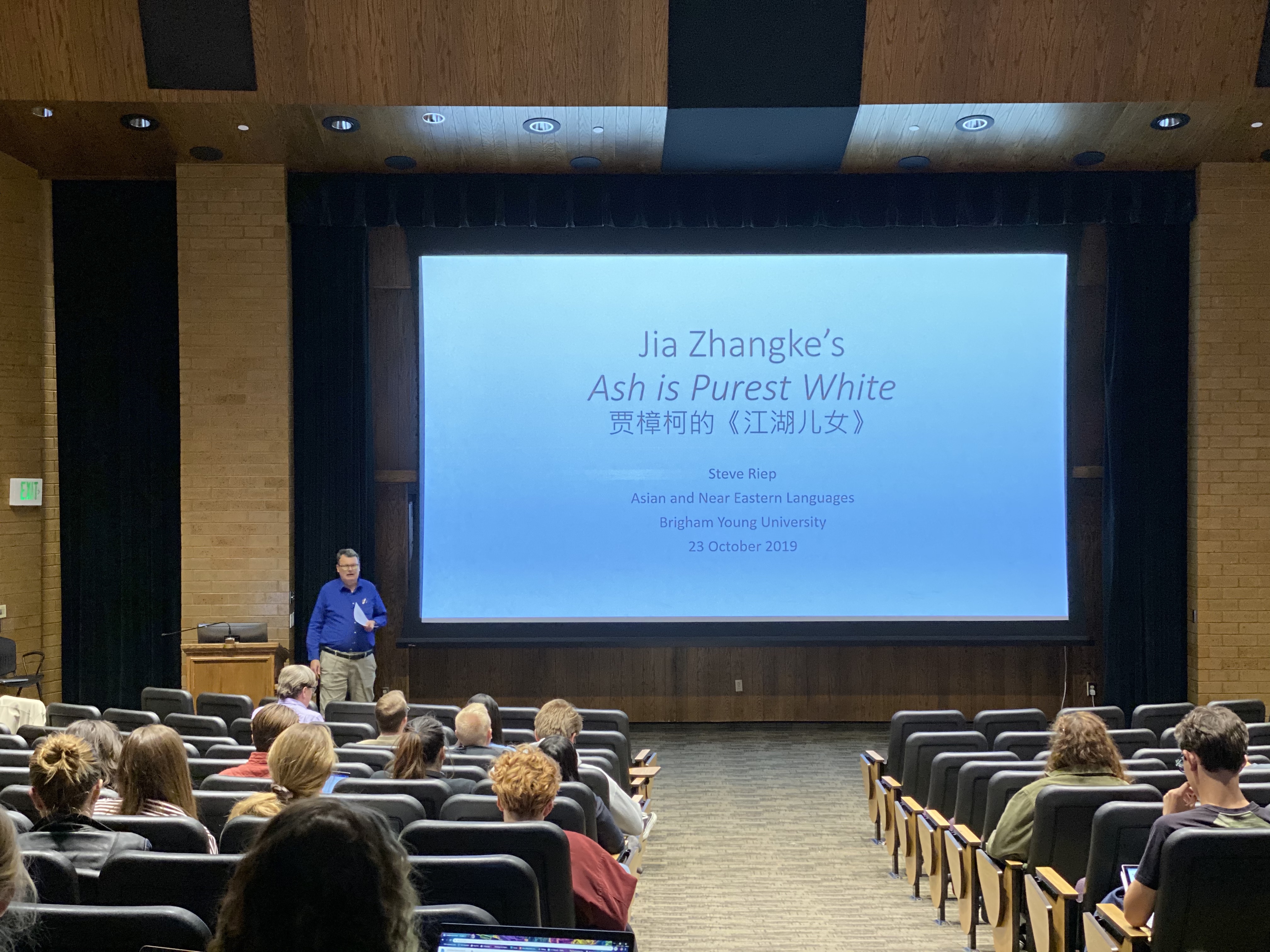
 

Ebb and Flow in the Films of Jia Zhangke

By | News

“Jia Zhangke is probably one of China’s most popular and best known directors,” said Dr. Steven Riep of the Department of Asian and Near Eastern Languages. Ash is Purest White (2018) is Jia’s latest film. Jia was born in Shanxi province in the 1970s—amidst the Cultural Revolution, which marked an incredibly turbulent time in China’s twentieth century. He first studied art, then after being inspired by Chen Kaige and Zhang Yimou’s film Yellow Earth (1984), he wanted to become a filmmaker. He went on to study at the Beijing Film Academy where Chen, Zhang, Tian Zhuangzhuang, and other famous Chinese filmmakers had studied. 

Notably, Jia is one of the foremost directors in the “sixth generation.” These are the Chinese directors who followed Chen, Zhang, Tian, etc. They are grouped together for their similar aesthetics and interests namely in using digital cameras, handheld cameras, and naturalistic lighting to make independent, underground films. They often focus on real life and urban areas and eschew costume, genre, and period films. Within Jia’s own filmography we see that he is especially interested in the massive changes in society, particularly the conflicts and compromises between communism and capitalism in contemporary China. He is also interested in alienation and disorientation in society. Both of these commonalities also appear in Ash is Purest White.

The film takes place over roughly seventeen years divided into three distinct acts with gaps in-between. It begins in 2001, at a small coal-mining town in Jia’s home province, Shanxi, which borders Inner Mongolia. This town, Datong, has been in decline as the coal business as been failing. Qiao (Zhao Tao) is dating one of the town’s leading crime bosses, Bin (Liao Fan). He is attacked by a group of up-and-coming rival gang members and is saved by Qiao firing off an illegal firearm. Qiao is sentenced to five years in prison but Bin only to one. The film then jumps forward to her release in 2007. Now Qiao is traveling along the Yangtze River in Central China as she tries to find Bin again. After they meet, the film then jumps forward another decade to 2017 and returns to Datong.

Riep noted that the film is placed in the International Noir series this semester and pointed out ways in which this was both accurate and misleading. Many noirs are crime dramas which Ash is, especially with its myriad of references to Hong Kong gangster cinema. Noirs also tend to explore existential philosophies about values and virtues which this film also does. Ash is not, however is not filmed in the same low-light, high contrast black-and-white style that is so prevalent in key film noirs, rather this film is fairly bright and colorful, especially in the second act. In many film noirs there are intense sexual motivations and while this film certainly has that between Qiao and Bin, the relationship is not noir-esque. Their relationship, while sexual, is more about loyalty and fidelity than the relationship in many noirs and Qiao is no femme fatale.

Lastly, one important key to understanding Ash is Purest White is the notion of jianghu. Literally, river and lake, jianghu has served as a euphemism for martial arts practitioners, castaways, and more recently, organized crime. Jianghu serves as a parallel world to the government in that it also features similar structures of bosses, middlemen, etc., and follows a strict moral code. Organized crime is intensely focused on loyalty to the system, the moral code, and to your leaders, not unlike the moral code of Confucianism. Qiao embodies this in her respect and care for her father, her hometown, and her boss/boyfriend. But is she loyal to a moral code and is she loyal to herself? 

A Kurosawa Film was Never Made Alone

By | News

“How many of you have seen a Kurosawa before?” asked Brandon Arnold who teaches in the Department of Theater and Media Arts. About half of the students raised their hands. “Seven Samurai (1954)? Rashomon (1950)?” Akira Kurosawa is one of the auteur directors whose last name is so significant in the world of film, you can drop the world “films” after his name. “What about High and Low (1963)?” Only about three students raised their hands. 

“Kurosawa is a lot like The Beatles to me,” said Arnold. Many people like The Beatles but relatively few have listened through their entire discography. Kurosawa directed thirty feature length films in his life so while many are fans of his work, most have not seen each and every film. Arnold then compared different Beatles albums to Kurosawa films. Sanjuro Sugata (1943) and Please, Please Me because both are fairly formulaic but showed great promise. Stray Dog (1949) and With the Beatles as great follow ups. Rashomon and A Hard Day’s Night garnered huge international recognition. Seven Samurai and Sergeant Pepper’s Lonely Hearts Club Band for being the greatest of all time and the one you’ve most likely encountered. Ikiru (1952) and “Hey Jude” for being optimistic works during an extremely pessimistic time. Dodes’ka-den (1970) and The White Album because they’re weird but kind of have something for everyone. Yojimbo (1961) and Let it Be for the return to basics. Ran (1985) and Abbey Road as they are both extremely ambitious. Throne of Blood (1957) and Revolver for their supernatural elements. Finally, High and Low and Rubber Soul in regards to how they are not usually the most well known works but once you find them you are surprised by the depth and breadth of these creators’ talents. 

Arnold also warned about talking about these films as if created by Kurosawa alone; all films, even these, are created with a massive amount of teamwork. Kurosawa actually worked with the same people over and over until they were named “kurosawa-gumi” or “Team Kurosawa.” These artists included actors (Toshirô Mifune, Takashi Shimura, etc.), writers (Hideo Ogumi, Ryûzô Kikushima, etc.), sound engineers (Ichirō Minawa, Fumio Yanoguchi, etc.), cinematographers (Asakazu Nakai, Takao Saitō, etc.), and his longtime assistant (Teruyo Nogami). These are just a few of the people who helped launch Kurosawa’s name and films into the upper echelons of cinema. Team Kurosawa focused on creating relatable characters in each of these films. Their soundwork, dialogue, photography, set designs, and acting all helped to realize this goal.

How Film Captured yet Continues to Humanize The Great War

By | News

“It moved me,” said Drew Tekulve (BYU Broadcasting) speaking of They Shall Not Grow Old (2018), not because of the film’s advanced technologies but because of how it made human those who lived over a century before us. Tekulve set out to demonstrate, “How film technology over the years has been used to improve memory and memorialize events. In this case, how the post-production processes in Peter Jackson’s They Shall Not Grow Old assist in memorializing the past.”

Tekulve began by giving an overview of the history of film technology from the 1880s to today by touching upon big leaps that have taken place over the years. In the 1870s, chrono-photography was a series of cameras that each took one photo and when shown in succession it acted as a primitive version of the moving pictures we have today. Celluloid film changed everything with its development in the 1890s. Celluloid could be loaded into a camera and cranked to capture a series of photographs along the film strips. In 1897, filmmakers began splicing film strips together to create movies as we know them today. Kinemacolor brought color to film in 1909. Kinemacolor is done by alternating shots through red and green filters then basically showing them together after processing to give at least some sense of rudimentary color in film; this was known as the “two-strip color/look.” The tri-chromatic procedure or the technicolor process in 1916 where three strips of film filtered through red, green, blue are layered to create almost every color our eyes can perceive. Technicolor was so groundbreaking and became increasingly inexpensive overtime that it persisted into the 1970s.

Other technologies have also been key in the development of cinema as we know it today. In 1927, The Jazz Singer became the first feature to be released with synchronized sound. 1932 marked the first film commercially released to use the full technicolor process with Walt Disney’s Flowers and Trees (not The Wizard of Oz, Tekulve reminded). Cinemascope was developed in 1953 which widened the frame of filmstrips which allowed cameras to capture even more space. Disney’s Tron was released in 1982 and became a groundbreaking work for its digital effects which are harsh on the eyes today but were nevertheless amazing advances in digital film technologies. Windhorse (1998) was the first feature film to be shot exclusively on digital cameras, and the Coen brother’s O Brother Where Art Thou (2000) was the first to use digital color-grading technology which allowed the film to have that sepia look despite being filmed in the summer. Nowadays, almost everything is done digitally: digital cameras, digital coloring, and all-digital post production. 

Peter Jackson came onto the scene with the release of his film Bad Taste in 1987, and as he began to make more and more money he founded a series of studios dedicated to film technologies specifically regarding post-production processes. He is now known best for the kinds of technologically boundary pushing work on The Lord of the Rings Trilogy as well as The Hobbit Trilogy (“questionable but still pretty good VFX,” joked Tekulve). But, according to Tekulve “They Shall Not Grow Old is Peter Jackson’s technological magnum opus.”

Jackson was given hundreds of hours of footage of the First World War from the Imperial War Museum and asked to create a film for the centennial of The Great War. The footage he was given wasn’t the original footage because overtime those filmstrips had decayed but overtime the museum created and preserved copies . Unfortunately, every time you make a copy it becomes more damaged and less clear. Jackson and his team chose to digitize and restore every piece of film in the museum at no cost to the museum because of his interest in WWI and his belief that these windows into the past needed to be preserved. 

The restoration process for the footage you will see in the film consisted of three steps. First, was frame rate standardization and interpolation. Because cameras in the 1910s were manually cranked, film strips were constantly being exposed as different speeds, and this is especially true with war footage. Someone in the trenches, whose heart was pumping, was probably cranking the camera like it would save his life while others may have been distracted by the soldiers cracking jokes so their frame rate slowed. Jackson and his team brought all the footage up to the standard of twenty-four frames per second which meant digitally adding frames as needed to create a motion that more closely matches real life. 

Second, they digitally added color to all of the footage. Using references from photographs of the same places today as well as surviving artifacts, they hand colored every scene in the film. Using photoshop, they would color one frame then use a program they developed to apply those colors to objects as they moved in each frame. The other frames were then checked afterwards. One important note, Dekulve added, is that the skin tones of every person are unique and even within one person’s face tones shift from nose to cheeks to ears so those all needed to put colored as well.

Last and, “the most insane part of the movie,” according to Dekulve, is the sound work in this film. They did original foley work (recording of sound effects) using the same types of weapons from Jackson’s and others’ personal archives of these artifacts. So the guns you hear in the film are the actual guns you see as well as the sounds of boots, tanks, cups, and every other item in the world of the 1910s. Not only did they add sound effects but they added the voices of the soldiers as well. While those could not be perfectly recreated, they analyzed the footage to find what region of the UK the speaking soldier’s were from and hired forensic lip readers in order to find out what they were saying. Finally, they hired actors from those specific regions to record the lines in the correct regional accent.

 “Why go through the lengths of doing this?” asked Dekulve, “Other than it looks beautiful, it sounds beautiful.” Jackson wanted to memorialized this often forgotten event. The humanity of the soldiers and those involved is restored along with the film strips. This film acts as an artifact for the history of World War I and important family history for those who had family members involved.

Mobs, Fogs, and Panique in Post-War France

By | News

“Atmosphere, atmosphere, atmosphere,” it’s the key to understanding the style of Julien Duvivier, the director of Panique (1946) according to Dr. Hudson of the Department of French and Italian. Duvivier was an early proponent of the poetic realism in pre-occupation French Cinema. Known for its dense, murky, fatalistic fogs that cover the lives of its characters, poetic realism oozed a sense of foreboding as it depicted an elite, bourgeois society was on the brink of collapse. Duvivier made many famous films in this style including Pépé le Moko (1937) and They Were Five (1936), both of which starred a frequent face at the IC, the unequaled Jean Gabin. 

At the outbreak of World War II, Duvivier fled France for the United States although films continued to be made in France during the occupation. The major French film studio, Continental Films, was personally overseen by Reich Propaganda Minister, Joseph Goebbels. These films were generally meant to be lighthearted affairs that were meant to do anything except criticize the ruling Nazi party. One film during the period that went against those dictates—and heavily mirrors the themes in Panique—was Le Corbeau (1943) by Henri-Georges Clouzot. In Le Corbeau, a small French town is thrown into a frenzy by a series of poison pen letters. An atmosphere of surveillance, distrust, and fear lies right beneath the surface. 

After the war, Duvivier decided to return to make films in France, but the France he returned to while radically different in some ways was still clutching to many of its past problems. Charles de Gaulle, chair of the provisional government at the time, called for épuration (a purge or purification) in France. All collaborators or those suspected of collaboration during the occupation were made to subjected to extreme cruelty including public humiliations of forced shavings or public nudity, imprisonment, and even death. One easy way to find a Nazi sympathizer they believed was to accuse anyone who were know to have held anti-semitic sentiments before the war. Unfortunately, this included almost a fifth of the population. 

The atmosphere of post-war France, the one director Duvivier returned to, was again a claustrophobic, distrusting fog. This is where Panique takes place. The film is set in Paris and the night before a carnival is to begin, a woman’s body is found. Very quickly, the veneer of neighborly friendless is questioned and the main character Monsieur Hire, played by “the man of a thousand faces,” Michel Simon, is suspected by all his neighbors. 

Dr. Hudson also suggested looking for underlying currents of retained anti-semitism in the film as well as the film’s use of tight framing, sharp angles, and low-key noir-esque lighting. Also look for how his accusers turn staples of French culture into suspicious behavior so quickly. The film ends with the lines, “Love of Mankind is the Beauty of the World,” which could be read as trite, according to Dr. Hudson, but he hoped we would see it as more of a positive wish to finish this dark film.

Subjectivity of Cameras and Personal Relationships

By | News

Benedetta Barzini wants to disappear. “But how do you film a disappearance?” asked Dr. Marie Orton of the Department of French and Italian. Dr. Orton began her lecture on Disappearance of My Mother (2019) by stating that this film is ostensibly a documentary and is also very divisive. Critics strongly disagreed with each other over the film and her goal was to force us to come away with our own conclusions and never to finish this film without one.

Barzini was an early supermodel. Despite how it seems nowadays, supermodels are a rather recently invented phenomenon. In the mid-1800s they began to use models for fashion. Previously, all clothing was displayed with mannequins. After photography improved, humans were brought in to model the clothing, but these women were still referred to as mannequins. In the 1940s, again as photography improved, there began to emerge famous photographers. As they gained more power they began to request certain models for their shoots. It was only once these models were in demand by photographers that they started to make their own names for themselves. In the 1960s, some models signed with specific fashion houses, and in the 70s and 80s they signed with specific brands. It was then that the supermodel as we know them today began. 

While the titular mother in Disappearance of My Mother, Benedetta Barzini, began her modeling stardom at only fifteen years old, she realized that the industry was benefiting more than she was. Barzini would go on to become a feminist, a marxist, an activist, and even a university professor — “The same trajectory as all of us,” Dr. Orton joked. Barzini was concerned about the prevalence of the gaze, particularly the male gaze, in the world of fashion and the way that gaze began commodifying women’s bodies. This is partly why she wants to disappear. 

The film does not give an overview of Barzini’s life and career, rather it is a series of vignettes on her life now. Like with all real people, the past is present but only when it’s relevant. Viewers of the film will certainly learn about her modeling career and her feelings about the industry but not through a traditional, cohesive narrative. 

Dr. Orton suggested that as viewers we watch for instances of viewing and representation. Barzini will look at the camera and defiantly turn it off throughout the film. How does the presence of a camera change a subject’s—or our own—behavior? How does it change relationships? With Barzini’s own son directing the film, we gain some access to his mother’s complicated life but their close relationship also obscures what viewers may find the most interesting. Dr. Orton finished by saying, “Documenting a disappearance is kind of a self deconstructed endeavor, and I think that’s the whole point. The lens, this economy of photographic representation, is always going to out maneuver any attempt to avoid it, because it’s impossible not to gaze.”

Horrific Realism of Refugee Children’s Experience at the US Border

By | News

Before screening of Icebox (2018) at the IC weekly lecture, Professor Kif Augustine-Adams (J. Reuben Clark Law School) began her presentation with a quote from Matthew chapter 25 verse 40: “Inasmuch as ye have done it unto one of the least of these my brethren, ye have done it unto me.” In addition to teaching in the law school, Professor Augustine-Adams co-founded the school’s Refugee and Immigration Initiative which brings law students to US border camps to help detained women and children to prepare for their court hearings and interviews. One of the initiative’s main focuses is helping people seeking refugee status to pass their Credible Fear Interviews. These are interviews conducted by the United States Government to determine whether someone can safely be shipped back to their hometown without fear of death or harm if they cannot, they are allowed to stay in the United States to continue their pursuit of refugee status. 

Professor Augustine-Adams recalled a harrowing story of a student who was working with a mother and young son. In order to keep the child busy while his mom relayed the horrors she was fleeing, the student drew a few circles on a piece of paper and asked the young boy to fill in the circles with people’s facial expressions in the camp. He began with his mother and the student then he moved slowly to others. He drew many faces before he was suddenly notified that his personal court hearing was just scheduled to take place in less than an hour. The student then had to help him prepare his statement. He decided to say, “If my mother needs to be sent back to our hometown, I want to stay in the United States. I will miss my mom, but I don’t want to die.” While telling this story, Professor Augustine-Adams tearfully displayed the drawings that this young boy made.

The images in Icebox, she said, are extremely realistic. The only unrealistic part, according to her experience with the camps, is how easily and quickly the Hondurian boy’s detention is resolved while in real life, and especially after the current US Administration removed the time limit on keeping children in detention camps people often stay much longer. Previously under the Flores Settlement, a law which established standards of care for migrant children, children could only be detained for twenty days before being released. As of August 2019, there are no longer time limits on detention. A human, no matter how young, now can be kept in the camps for an indefinite period of time. She added that the depictions in the film are not as bad as the real conditions for people today claiming, “This was back in the ‘good times.’”

Prof. Augustine-Adams makes the point that people’s rights–and specifically children’s rights–are being taken away at every level in this process. They no longer even have access to education and English classes as of June 2019, so now children just sit idly with nothing to do for days, weeks, and months on end. She urged people to get out and vote, to contact your elected officials, and reach out to your neighbors. Children should not be forced to represent themselves in court as the young Hondurian boy does in Icebox.

To end, she shared a lyric from Lila Down’s Clandestino: “If we don’t fight for the children, what will become of us?” https://youtu.be/jHn5DJPdgEY

Re-thinking Rom-Coms?

By | News

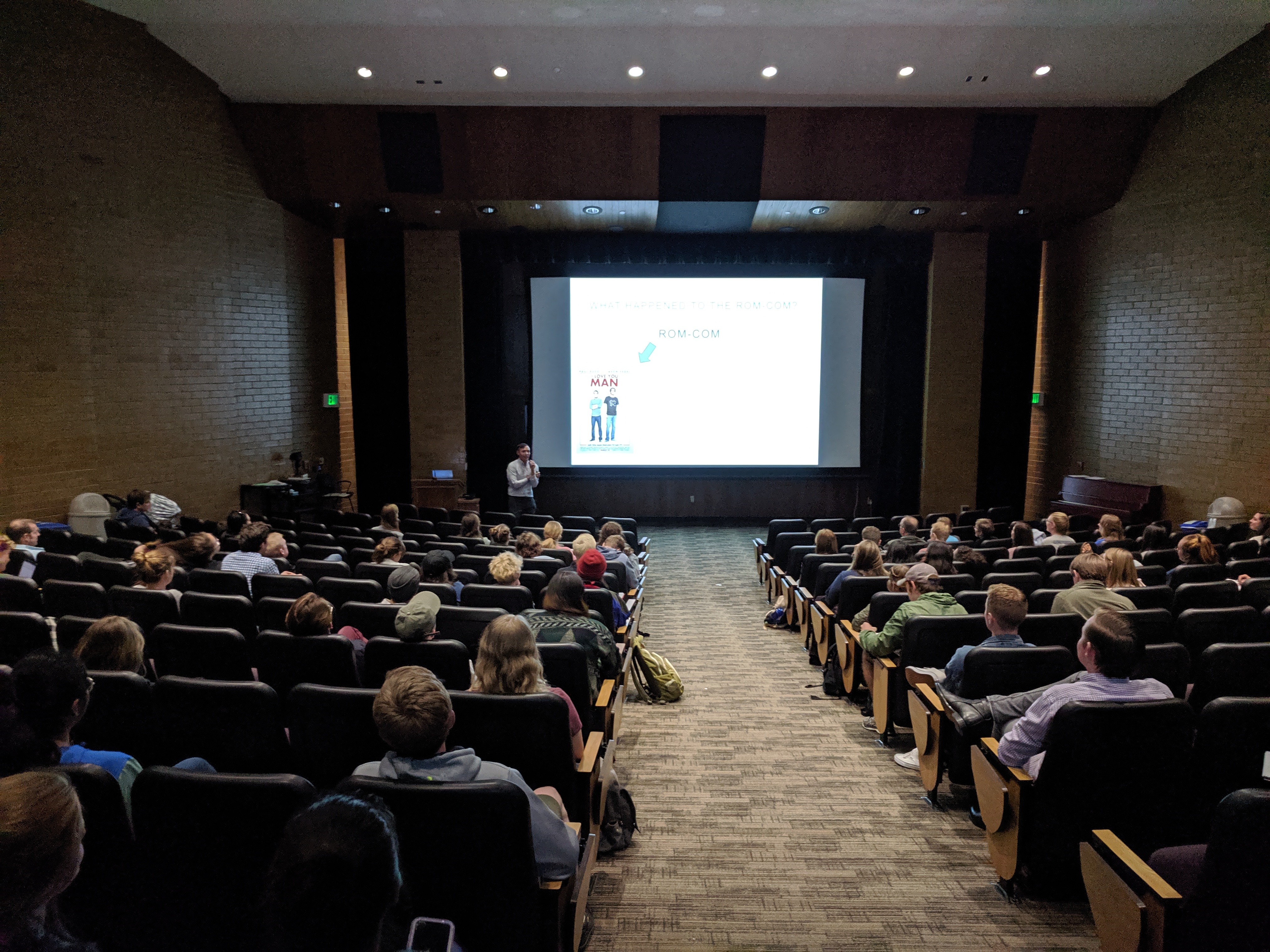
“Is the Rom-Com dead?” Some hands warily raised while others remained still. Dr. Marc Yamada from the Department of Comparative Arts and Letters is currently serving as one of the co-directors of the International Cinema. One of the co-directors’ main responsibilities is to choose the films shown each semester. Yamada knows that the romantic-comedy Crazy Rich Asians (2018) is not the typical fare here, so the goal of his lecture was to provide a context for why this film belongs at the International Cinema.

Romantic-comedies, while not in the mainstream film industry as strongly anymore, are very much still alive. Many minority cinemas have adopted the rom-com formula to tell new stories about their specific group dynamics. In recent years, there has been a huge influx of rom-com’s in American Black cinema, LGBTQ cinema, and—most recently—Asian cinema. What was typically the love triangle between one woman and her two male suitors has now become a framework for discussing issues of class, race, gender, and sexuality. Crazy Rich Asians, as you may suspect, is primarily about class and race, but gender finds its way in as well.

The film is concerned, Dr. Yamada argued, with the question, “What does it mean to be Chinese?” Is the answer determined by ethnography? Geography? Linguistics? Citizenship? Crazy Rich Asians invites viewers who previously thought of all Chinese people as homogenous, to see the differences in Chinese communities around the world. The film follows Rachel Chu (Constance Wu) who acts as the outsider’s insider. She’s Chinese-American and fits the stereotype, according to her, as she’s “an economics professor with lactose intolerance.” Rachel is invited to accompany her Chinese-Singaporean boyfriend to a huge wedding event between two elite families in Singapore. She naively believes that she’ll get along with everyone because “she is Chinese.” It comes as a surprise to Rachel to find that not all Chinese communities are the same.

Dr. Yamada proposed that the rom-com formula is used to explore these differing identities. Instead of the regular meet-cute we see in older rom-coms, the romantic leads have already met and are seriously dating when the film begins. Additionally, the love triangle is seemingly done away with as there are no other men pursuing Rachel, but Dr. Yamada argued that the love triangle, has not been trashed, it has been transformed. The triangle is not one of romantic love between three individuals but of maternal care and identity between Rachel, her mother, a Chinese-American, working-class immigrant and her boyfriend’s mother, the powerful, traditional, and wealthy matriarch (played by the unparalleled Michelle Yeoh). These three women’s interactions in the film directly relate to the key question Dr. Yamada asked, “What does it mean to be Chinese?”

As suggested earlier, the film does not only use the rom-com formula to explore race and class but gender as well. As opposed to the older Asian male stereotypes of “Evil Other,” “Wise Master,” and “Side-kick,” and the newer stereotype of soft masculinity (as seen heavily in the pop music from Northeastern Asia), the film is very interested in a more masculine, Asian male. The men in the film receive affection not only narratively from their female partners, but cinematically from the camera.

Dr. Yamada concluded by asking us to be wary of the stereotypes put forth in this film. Not all Asians are as wealthy and hyper-materialistic as depicted in this small slice. Rampant maid exploitation is the sweat that makes the “Crazy Rich Asians’” lifestyle possible. To combat this, the International Cinema is also showing a companion piece this week of Koreeda Hirokazu’s newest, Palme d’Or winning film Shoplifters (2018), that shows the flip side of this wealth disparity.

The Ethnographies of Anime

By | News


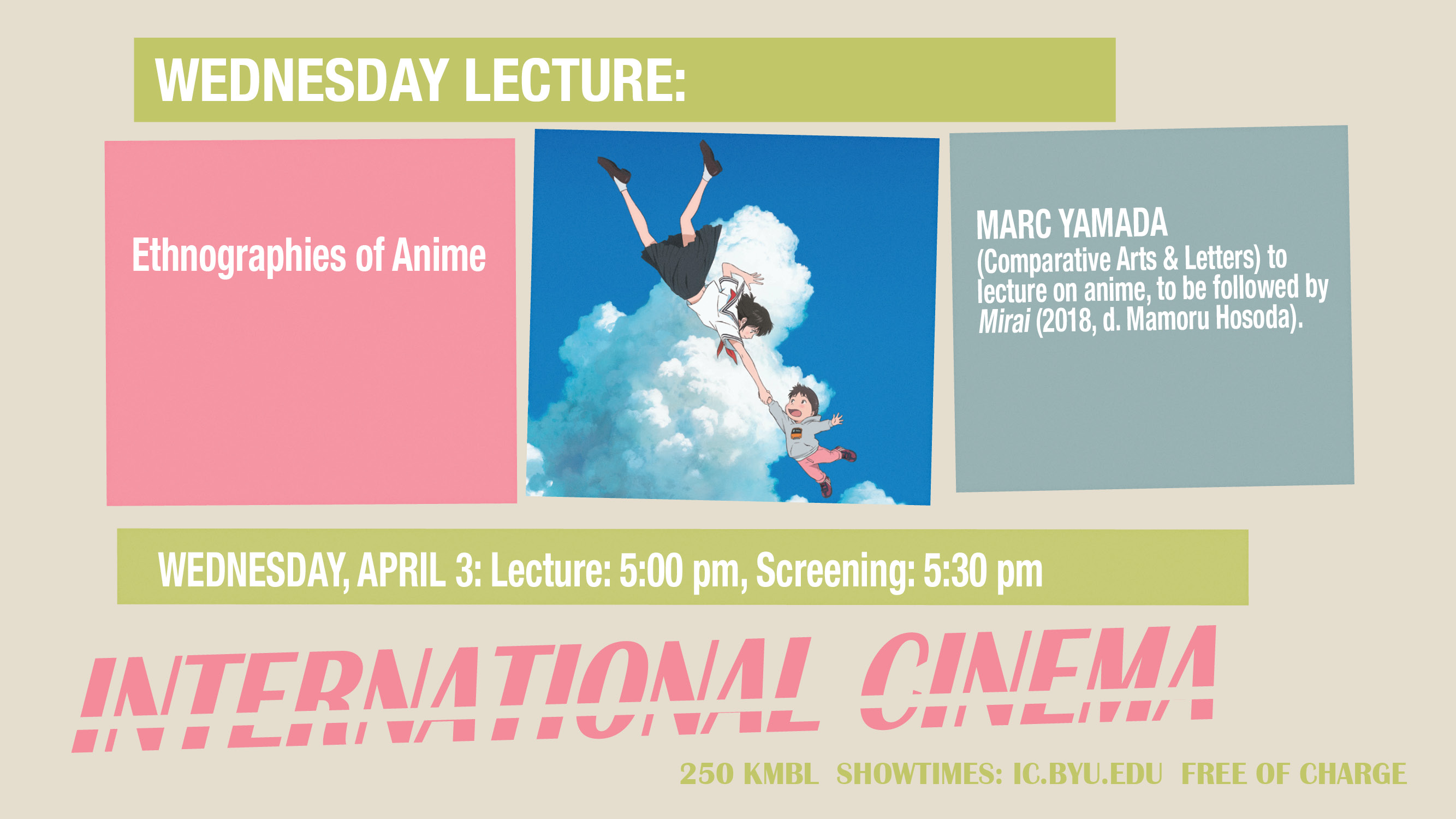
PROVO, Utah (April 3, 2019)—Anime. This word brings to mind different things for different people, including ninjas, magical girls, and adorable, doe-eyed protagonists. This style of animated Japanese film and television is something that has become vastly popular in the last few decades. Whereas before, anime was seen as a niche interest, it is now a very mainstream media form that appeals to people from all walks of life.

Professor Marc Yamada (Comparative Arts and Letters) discusses three main characteristics of modern anime.

In his lecture on the themes present in anime, Professor Marc Yamada noted how many times, entertainment becomes something that spans more than one type of media: “We don’t just read novels; we also watch the films, we go to theme parks, we even buy Lego sets.” Yamada used the Harry Potter series as an example, explaining how “we don’t really want a narrative experience of Harry Potter [when watching a film]; we get that in the novel. What we want are two things. The first is to be immersed in the world of Harry Potter. The second is to interact with the characters in the story.”

Yamada went on to say how characters are what connect the different media forms together. In the case of anime, several well-known anime (such as Naruto) began as manga series, Japanese visual novels or comics. Many of these eventually go on to become video games as well, but they all use the same characters that keep the different media consistent with one another.

How designers create these characters becomes the next important question to the success of anime. “The traditional way of thinking about this is there’s one creator behind these characters,” Yamada explained. “There’s a mastermind, there’s Miyazaki. He sketches these characters, creates them, and rabid anime fans consume them.”

Although this may be the traditional way of thinking of character creation, Yamada stated that it is more often a collaborative process that brings about these beloved characters: “We have to think about the larger studio that’s behind Miyazaki. It’s not just him. He has a whole studio of animators, sound technicians, all these people working together to create these characters.” Yamada went on to explain how modern fans have become more than just passive consumers. Fan bases often have great input into the creative process that both influences and inspires what the creative teams ultimately do.

In the early days of animation, all animated films had to be drawn by hand, frame-by-frame. Modern technology has drastically changed this; with the power of CGI, the animation process has become much less time-consuming. On the one hand, this change allows more anime than ever produced quickly, but on the other, the traditional ways of making anime are starting to disappear. Yamada noted how directors now are trying to preserve tradition while still taking advantage of new technology. Director Mamoru Hosoda, for example, often juxtaposes hand-drawn characters with CGI-made backgrounds. “There is an interesting tension going on in the animation world,” Yamada noted.

Rich, relatable characters, collaborative creative teams, and rising tension between traditional and modern ways of animating all come together to make anime a unique form of both art and entertainment. Within the stories of Miyazaki, Hosoda, and others can be found tales of family, of collaboration, and of the process of creating art itself. It is no wonder, then, that anime has ceased to be niche and has instead become an art form where nearly everyone can find a bit of themselves looking back at them.

—Jensyn Eubank (English ’20)

Original article published at: https://humanities.byu.edu/the-ethnographies-of-anime/

Gender and Genre in Farewell My Concubine

By | News

Professor Francesca Lawson (Comparative Arts and Letters) discusses the roles of gender and genre in Chinese opera, and relates it to Chen Kaige’s film Farewell My Concubine.

PROVO, Utah (March 27, 2019)—Chinese opera is one of the most world-renowned part of China’s long and rich artistic culture. Since the time of the Tang Dynasty (618–907 AD), opera has been loved by many generations. On the stage, actors portray stories of love, bravery, and sacrifice in an attempt to speak to the human heart.

One such story, the king and the concubine, has been around for hundreds of years. The folktale is based on the true story of the warlord Xiang Yu and his concubine, Yu Miaoyi. Faced with imminent defeat by the hands of enemy warlord, Xiang Yu found himself abandoned by all his men. Only his concubine stayed by his side, pledging her undying loyalty to him before committing suicide to prove she would never leave him.

Professor Francesca Lawson spoke of the genre fluidity of Chinese opera. “The idea of adaptation, which usually in the west is from novel to film, is seen on many different levels in Chinese culture, and it’s part and parcel of the culture,” she stated. “The Chinese are the best recyclers in the world. They can take any idea and find a multiplicity of ways to express it.”

Like genre, gender is fluid in traditional Chinese opera. Lawson noted how “gender boundaries are much more fluid in the Chinese culture than they are in western European and North American cultures.” She went on to explain how historically in China, opera troupes were generally all-male. As such, certain men would be chosen based on their looks and mannerisms to fulfill the Dan (female) roles.

The fluidity of the genders in Chinese opera made the male Dan extremely popular. Lawson attributed this to the fact that “Men appreciated seeing the male Dan because they could focus on the Dan’s artistry rather than become distracted by the body of a female actor.” The male Dan appealed to others as well; Lawson noted that “They were adored by women because of the sympathetic portrayal of female characters. And people of all sexual orientations enjoyed male Dan because of the inherent androgyny of the character.”

Both the fluidity of genre and gender helped lead to Chen Kaige’s film, Farewell My Concubine. Lawson recalled how at first in the story of the king and concubine, the king was the main focus of the story. This changed when, thanks to famous female impersonator Mei Lanfang, a version of the story was made for the stage where the concubine took precedence. Lawson explained how the concubine’s virtue and loyalty was highlighted, while the king became a less-important, very flawed character. From there, the story was adapted into Lillian Lee’s novel and finally into the 1993 film, Farewell My Concubine.

The film follows the stories of two opera actors as they endure nearly fifty years of China’s history, from the 1920’s through the Cultural Revolution of the 1960’s.  As both Duan Xiaolou (who plays the king) and Cheng Dieyi (who plays the concubine) have to adapt and endure their country’s changing values, the audience sees the same loyalty found in the story of the king and his concubine.

Lawson observed how “Their entire lives kind of reflect the same sort of relationship,” with both genre and gender fluidity playing major parts in the two men’s lives. The genre of stage acting becomes blurred with their real lives as the two go in and out of their roles but still reflect the values and flaws that their characters embody. Even the boundaries of gender are tested; Cheng Dieyi finds himself becoming androgynous to both himself and others on several occasions as he nearly gets lost in his role as the concubine.

By blurring traditional ideas of both genre and gender boundaries, Farewell My Concubine tells the same stories of love and sacrifice in a new way. In the end, Lawson noted, when “the pressure’s on Duan Xiaolou to ‘Give in, give in,’ he does.” Even then, when even his dearest friend has betrayed him, Cheng Dieyi stays true. Lawson concluded by saying that “the triumph of the film is really Cheng Dieyi’s enduring love both for Duan Xiaolou and for his dedication to the art of Chinese opera.”

—Jensyn Eubank (English ’20)

Original article published at https://humanities.byu.edu/gender-and-genre-in-farewell-my-concubine/